The dashboard
Nobody looks after the meeting
Built on definitions nobody agreed to, so every team defends a different number — and nobody trusts any of them.
Soltura watches what your business has committed to: purchases that complete, invoices that get paid. When something fails, it gets a name and an owner, and it isn't resolved until the number is back where it belongs.
Are checkouts completing as we agreed?
No. Checkout completion is at 40% against the agreed ≥ 80%, since August 8. Commerce owns this promise. Here is the history: four earlier episodes and one still open.
Checkout completion
40% against ≥ 80% agreed. Outside the agreed range since August 8: INC-1104 is still open. The four earlier episodes recovered.
Where are we losing them today?
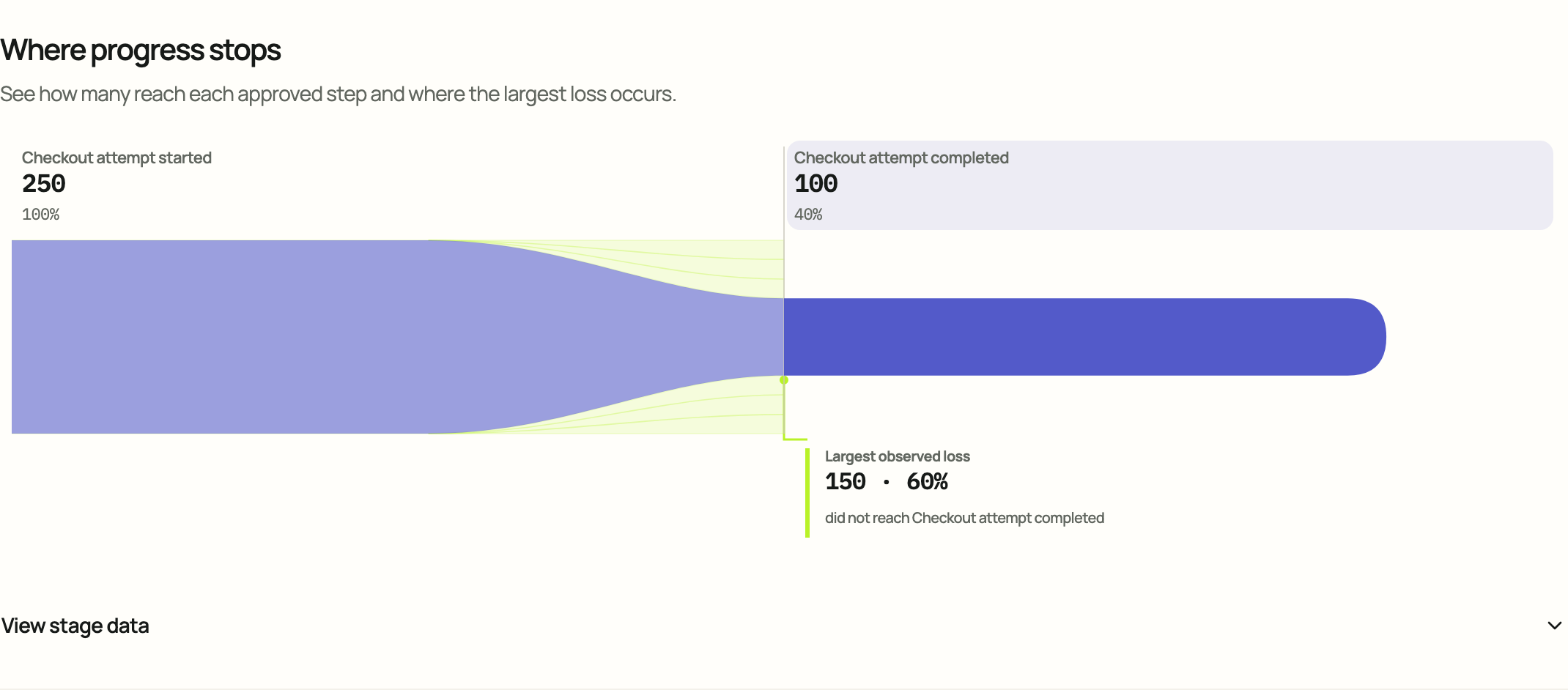
Today, 100 of 250 qualified sessions confirmed an order: 40%. The largest loss is at payment: 168 started paying and 108 were authorized, so 60 never got past that step.
Checkout completion
Today. The same 250 eligible checkout attempts, from qualified session to confirmed order.
Is anyone on this?
Not yet. INC-1104 opened on August 8 and nobody has picked it up. The last time this slipped, in June, Alex Rivera from Commerce took it:
This is how it reads in Claude or ChatGPT with your account connected. The data here is a demo.
Installs from Claude Code, Codex, or Cursor. The first session agrees the question with you. It does not open a pull request. After you confirm, you can see that question in Cloud, waiting for events.
The problem
Business numbers get answered once and nobody looks again. When they fall, a chart can't tell lost sales from events that stopped arriving. And the alert, if there is one, has no owner.
And when someone does look, every team is measuring something different: overdue since the due date, the reminder, or the promise to pay? Soltura pins the definition down before anything is measured.
What Soltura does
“Priority products don't run out before restock arrives.” An explicit definition and boundary, reviewed like code.
If everything is inside its range, there is nothing to look at. A quiet morning is good news.
Someone picks it up and investigates from what Cloud already knows, with their agent and their tools. What they find gets noted.
Nobody closes an incident by writing “fixed”. The data does.
What you already have
The dashboard
Built on definitions nobody agreed to, so every team defends a different number — and nobody trusts any of them.
The alert
A threshold in the monitoring tool or a Slack channel: no owner, no close, and no way to tell whether the business failed or the measurement did.
Soltura
The promise is defined and reviewed like code. When it fails, someone has it. It closes only when the number returns.
Questions already answered
Bring your own question, or start from one of these. Every answer below is captured from the running product using synthetic demo data.
 Conversion
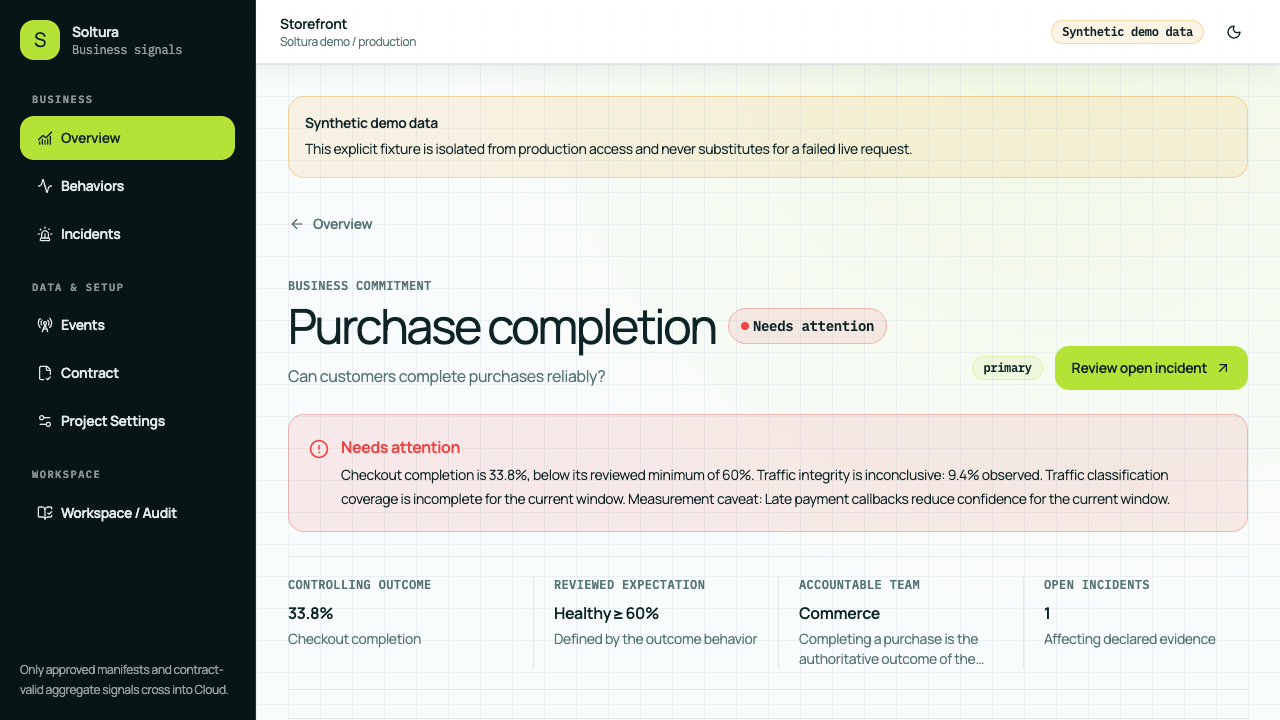
Checkout completion is outside its range. Soltura flags it; you decide how to dig in — from Cloud or by continuing in the skill. Once it recovers, the incident is logged and its history stays available for future incidents.
See what happens after it slipsLive answer
Overview points at what needs attention. Each promise brings its trend, its evidence, and the next decision. If a promise stops holding, the people who need to move hear about it — and hear again when it holds.
Can we keep priority products available?
Products without dependable stock evidence are left out, not estimated.
How it’s possible
Soltura doesn’t ask for an event plan. You ask the agent that already knows your code — Claude Code, Codex, or Cursor — and it first agrees what counts. When you are ready to measure it, that later session proposes the minimum instrumentation as a normal pull request. Only approved events leave the repository; the code never does.
Source code, agent conversations, diffs, logs, raw payloads, and secrets stay in your environment. Soltura receives only the signal contract and aggregate events your team approves.
Use the Soltura skill. Can customers complete purchases reliably?
I mapped one outcome and the events needed to measure it.
minimum evidence path
checkout_startedcheckout_payment_submittedpayment_resolvedorder_confirmedApprove the contract, files, and tests? [y/N] y
reviewed change prepared
pull request ready for reviewafter merge: approved signals → Cloud
What it costs
Start free on one real question. When it outgrows the free band, a simple recurring agreement adds capacity — what gets metered is the commitment you keep answerable, never the people reading the answer.
Free
FreeTeam
€99/monthBusiness
Recommended€349/monthEnterprise
Let’s talk| Feature | Free | Team | Business | Enterprise |
|---|---|---|---|---|
| Price | Free | €99/month | €349/month | Let’s talk |
| Active commitments | 1 | 5 | 20 | Contracted |
| Included events / month | 250,000, hard-capped | 1.5M | 6M | Committed volume |
| Excess events | Pause, no invoice | €0.10 per 1,000, capped | €0.10 per 1,000, capped | Agreed terms |
| Raw events retained | 30 days | 90 days | 180 days | Tailored |
| Question history | Complete | Complete | Complete | Complete |
| Workspaces | 1 | 3 | 10 | As many as you need |
| Collaborators | Included | Included | Included | With governance |
| Context collection | None | 1,000 attempts, then pause | Contracted | Contracted |
| Support | Community | Standard | Priority | Contracted SLA |
| SSO and advanced governance | — | — | — | Included in the conversation |
| Get started | Start free | Start with Team | Start with Business | Talk to us |
Invalid, rejected, and duplicate events never count. You pay for accepted evidence — nothing else.
250,000 free events a month. No card. Your code never leaves the repository